
Every generation of musicians inherits a new set of tools.
Some are mechanical. Some are electrical. Some are digital. Some are software. Now, some are generative.
What changes is not the existence of tools. What changes is the speed, scope, and surface of what they make possible.
What has not changed—despite persistent confusion—is where authorship lives.
Tools Have Always Shaped Sound
Modern music has never been created in a vacuum.
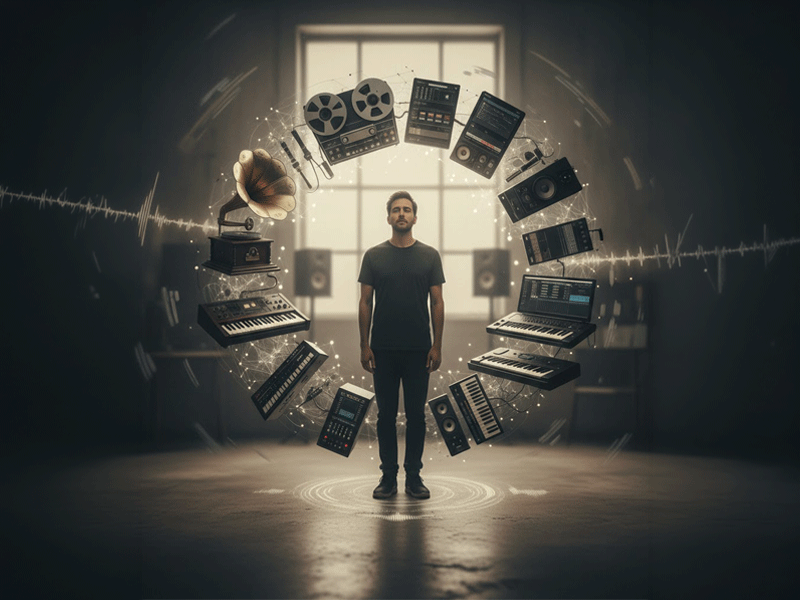
Multitrack tape changed composition. Synthesizers changed timbre. Samplers changed structure. DAWs changed editing. Loop libraries changed workflow. Pitch correction changed performance expectations.
None of these tools erased authorship. They relocated effort.
Each shift compressed one part of the process and expanded another.
No one asked whether a sequencer "cheated." No one demanded that a sampler justify its legitimacy. No one accused a DAW of undermining creativity because undo existed.
The argument was never about purity. It was about unfamiliarity.
The Real Shift: From Execution to Editorial Judgment
As tools improved, one thing became increasingly clear: The burden of creativity moved away from execution and toward selection.
When recording was destructive, skill lived in capture. When editing became non-linear, skill lived in decision-making. When sound became abundant, skill lived in taste.
This is not a loss of authorship. It is a refinement of it.
Choosing what stays became more important than proving how hard it was to make.
AI Doesn't Change This — It Clarifies It
AI enters the lineage here, not as an anomaly, but as an accelerant.
It compresses: discovery, variation, iteration, exploration.
It does not remove: intention, judgment, responsibility, authorship.
An AI system can generate options. It cannot know which option matters.
It cannot know: when phrasing breathes, when emotion lands, when something feels inevitable rather than assembled.
Those are editorial decisions. They always have been.
Authorship Has Never Been About Doing Everything Yourself
This is where confusion creeps in.
Authorship is not defined by: how many steps you performed manually, how long it took, how much friction you endured, how much suffering you can document.
Authorship is defined by: what you chose, what you rejected, what you shaped, what you released, what you stood behind.
A composer who writes for an orchestra is still the author. A producer who assembles sound is still the author. A musician who edits relentlessly is still the author.
Tools do not dilute authorship. They expose it.
The Myth of the "Untouched" Human Essence
There has never been an untouched, tool-free human essence in music.
Every era has had its leverage: instruments, notation, studios, engineers, machines, software.
What people defend is rarely purity. It is familiarity.
The discomfort is not that tools exist. It's that the locus of skill has moved again—and some identities are built on where it used to live.
What Still Hasn't Changed
No tool decides when a piece is finished. No system knows what should be cut. No machine understands context, meaning, or consequence.
That responsibility has never been outsourced. It cannot be.
The tools evolve. The authorship doesn't. It still lives in the human who chooses.
Closing
This moment doesn't demand new definitions of creativity. It demands clearer ones.
If a tool expands possibility, the question isn't whether it belongs. The question is whether someone is willing to take responsibility for what comes out of it.
That's where authorship has always lived.