

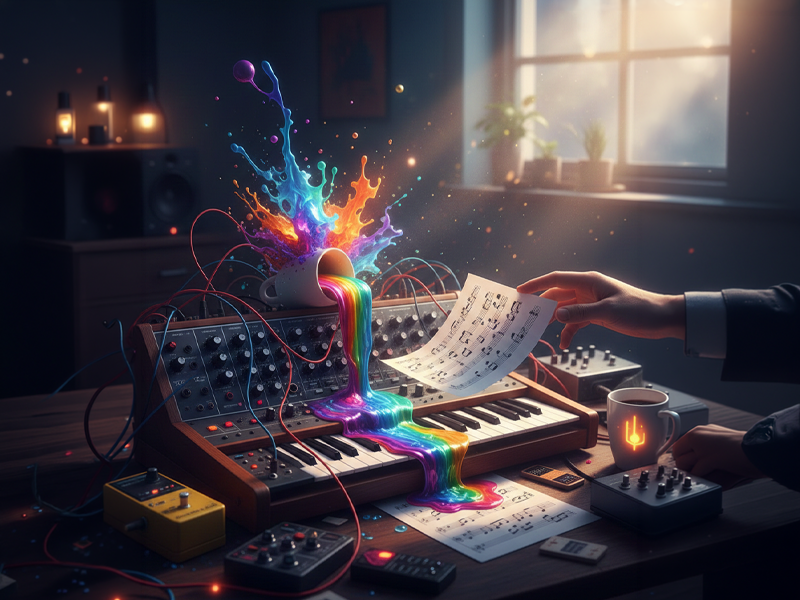
History is full of great accidents.
It's not full of great accidents that succeeded on their own.
That distinction matters more than most creative debates admit.
Accidents Are Common. Outcomes Are Not.
Music history is littered with moments of chance: a riff stumbled onto at the end of a session, a wrong note that became the hook, a sound discovered while testing something else.
None of this is controversial—until people become threatened by the tools involved.
Then suddenly, the accident itself is treated as suspect.
Luck Is Accepted Almost Everywhere Else
If someone drops a quarter into a slot machine and wins a million dollars, no one launches an ethical inquiry.
If someone succeeds because they were in the right place at the right time, no one demands they give it back.
If someone discovers value quickly instead of slowly, the result still belongs to them.
Luck is accepted almost everywhere—except where discomfort about tools enters the picture.
That discomfort says more about disclosure anxiety than ethics.
Ease Doesn't Invalidate Ownership
If you find gold in a stream, it's yours.
Ease doesn't invalidate discovery. Effort isn't a prerequisite for legitimacy.
What matters is what you do next.
A Riff Is Not a Record
A compelling riff—even a lucky one—is not a song.
A loop is not a finished work. A phrase is not a career.
What follows is the work: development, arrangement, editing, production, performance, release, promotion.
Most ideas don't fail because they were unearned. They fail because no one carried them forward.
History doesn't remember accidents. It remembers completed work.
Modern Music Has Long Incorporated Found Material
Modern recorded music has long incorporated found material.
Drum loops didn't end music. Sample libraries didn't dilute authorship. Preset synths didn't erase creativity.
They accelerated early stages and lowered barriers.
What separated meaningful work from noise was never the origin of the material. It was judgment, taste, and follow-through.
AI doesn't change that equation. It compresses the discovery phase.
Chance Still Requires Responsibility
Here's what critics consistently miss: accidents don't remove responsibility — they increase it.
If something lands in your lap—by chance, by tool, by intuition—you still have to decide: Is this worth finishing? What does it want to become? What should be cut? What should never be released?
Most failures happen after the accident, not before it.
The Economic Reality No One Mentions
And the numbers make this clear:
Most people don't profit from happy accidents. Most spend time, money, and energy developing ideas that never recoup their cost.
Which makes the obsession with how something began even stranger.
The risk is already real. The work is already unpaid. The outcome is already uncertain.
Why This Argument Keeps Coming Back
The fixation on "lucky output" isn't really about fairness.
It's about fear: fear that effort isn't always proportional to reward, fear that control is limited, fear that outcomes can't always be justified cleanly.
Music has never promised fairness. It has only offered opportunity.
The Only Question That Matters
The question is not: How did this appear?
The question is: What did you do with it?
Did you shape it? Did you finish it? Did you stand behind it?
That's where authorship lives.
Where This Leaves Us
Happy accidents don't make songs. People do.
And sometimes, being lucky is simply the beginning — not the end — of the work.