

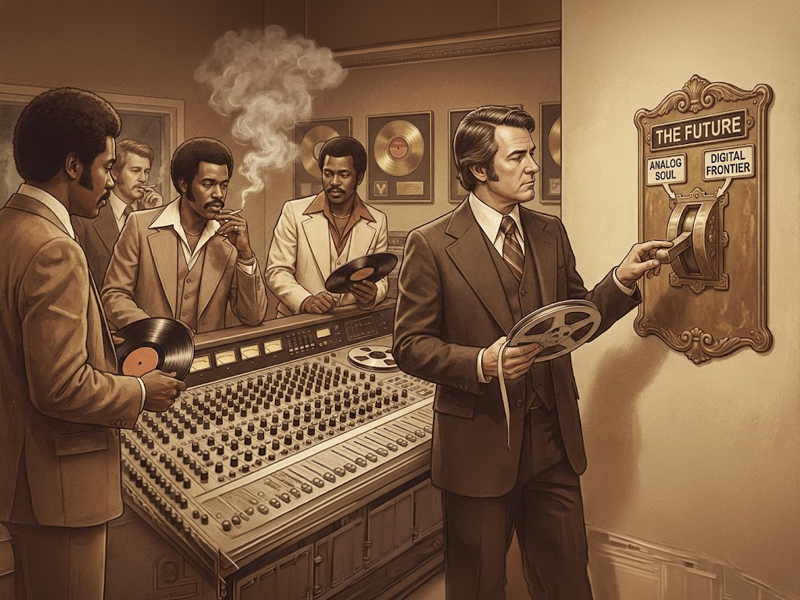
Before AI entered music, the industry had already made a decision about what music was worth.
That decision wasn't announced. It didn't arrive with a manifesto or a public reckoning. It emerged gradually—through contracts, platform economics, and business models that reshaped how recorded music was valued, distributed, and paid for.
By the time AI tools appeared, the outcome of that decision was already visible.
AI didn't create the problem. It arrived after the problem was well established.
The Shift to Digital Abundance
The first major rupture wasn't AI. It was digital distribution.
When music became infinitely copyable, control over recorded sound collapsed. File sharing normalized the idea that music could move freely, detached from payment. The industry failed to contain that shift and eventually attempted to monetize access rather than ownership.
Music stopped being sold primarily as something listeners owned and became something they accessed through platforms.
This change didn't just alter consumption. It changed how value flowed—away from individual works and toward scale, aggregation, and attention.
Streaming and the Attention Economy
Streaming platforms didn't restore what digital disruption removed. They formalized it.
Recorded music became abundant, searchable, and always available—but rarely lucrative for individual artists. At the same time, social media platforms rose alongside streaming, reshaping how music circulated and how success was measured.
Discovery became metric-driven. Visibility became essential. Output mattered more than resolution.
Artists were no longer just expected to write and release songs. They were expected to remain visible inside systems designed to reward interruption rather than completion.
Songs were shortened. Singles replaced albums. Moments replaced bodies of work.
This didn't necessarily produce better art. It produced more noise competing for limited attention.
Tools Evolved, Expectations Expanded
Production tools didn't suddenly improve overnight. They evolved steadily—through sampling, loop libraries, digital workstations, and software-based studios.
Easier tools increased both participation and output.
More people could make music, and more music could be released. This expansion wasn't driven by panic or urgency. It was driven by accessibility.
Standing out was already becoming harder—long before AI.
Where AI Actually Entered
AI didn't arrive as a single disruption. It appeared across nearly every part of the creative process at once.
Music production. Visual creation. Video editing. Promotion and content packaging.
The result wasn't less work. It was more material to manage.
AI didn't change the underlying economics. It accelerated existing conditions by reducing friction everywhere at the same time.
More output. More versions. More competition for the same attention.
The End of A&R Was Not an AI Event
Long before AI, human judgment was already being replaced by metrics.
A&R didn't disappear because artists became less talented. It faded because data was cheaper than discernment. Engagement statistics replaced listening. Momentum replaced belief.
Artists were increasingly expected to arrive with proof—followers, numbers, traction—before receiving support.
AI didn't end this model. It inherited it.
Value, Effort, and Resistance
Much of the resistance to AI isn't really about technology. It's about discomfort with ease.
There's a deeply rooted belief in creative culture that effort equals legitimacy—that struggle validates output, and efficiency invites suspicion.
But the question remains unavoidable: If the result is good, does it matter how much suffering produced it?
Difficulty doesn't establish authorship. Decision-making does.
The Actual Fault Line
The ethical question has never been whether tools generate material. Tools always have.
The question is authorship.
Who decides what stays. Who decides what goes. Who stands behind the work.
AI can generate possibilities. It cannot make those decisions.
That responsibility remains human.
Where This Leaves Us
Before AI, the music industry made its choice.
It chose access over ownership. Scale over sustainability. Metrics over judgment.
AI didn't make music worthless. It exposed how little value was already being protected.
The human role hasn't disappeared. It has narrowed.
Selection. Judgment. Refusal. Commitment.
The work now isn't to outproduce machines. It's to out-decide them.